
RAIET IMPACT ACROSS ZIMBABWE
10 Provinces. 72 Districts. Schools at the Centre.
Qurious Mind Zimbabwe’s RAIET initiative is building a national foundation for robotics, artificial intelligence and emerging technology education. Through capacity development, district-level implementation, school engagement, practical robotics and global exposure, the initiative is helping connect national education priorities with meaningful learning experiences for educators and learners across Zimbabwe.
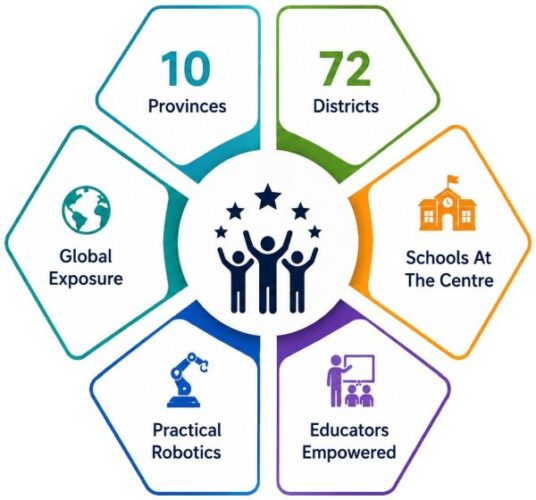
10 PROVINCES
National RAIET capacity-development footprint has been established and continues to gain traction across Zimbabwe’s ten provinces. This growing national reach is helping create a stronger foundation for robotics, artificial intelligence and emerging technology education across the country’s education system, while supporting the development of future-ready skills among educators and learners.
72 DISTRICTS
District-level cascading forms part of the national pathway towards deeper school-level implementation. By extending RAIET capacity beyond provincial structures and into districts, the initiative creates opportunities for knowledge, skills and practical approaches in robotics, AI and emerging technologies to reach more schools and education communities.
SCHOOLS AT THE CENTRE
Implementation is progressively moving from national and provincial structures to districts, clusters and individual schools. Placing schools at the centre helps translate RAIET priorities into meaningful learning experiences, creating opportunities for educators and learners to engage with technology through practical, collaborative and innovation-focused activities.
EDUCATORS EMPOWERED
Teachers and trainers are being equipped to translate RAIET concepts into practical learning experiences. By strengthening educator capacity in robotics, artificial intelligence, coding and emerging technologies, the initiative supports teachers in bringing relevant technology-enabled learning into the classroom and creating opportunities for learners to develop confidence, creativity and problem-solving skills.
PRACTICAL ROBOTICS
Qurio educational robotics kits enable learners to move from theoretical understanding to building, experimenting and problem-solving. Through hands-on robotics activities, learners can explore concepts through practical application while developing skills in computational thinking, creativity, engineering, coding, collaboration and innovation.
GLOBAL EXPOSURE
International partnerships and immersion opportunities are opening pathways for Zimbabwean education leaders and learners to engage with global innovation ecosystems. These opportunities provide exposure to emerging technologies, international perspectives and new approaches to innovation, helping connect Zimbabwe’s education community with the wider global technology and STEM landscape.